Blog
How to Tell if Jingdezhen Porcelain Is Hand-Thrown or Machine-Pressed

Many people ask: How can you tell whether a ceramic teaware piece is hand-thrown or machine-pressed? There’s actually a key point that can help you make a quick and accurate judgment.
[Hand-Thrown]
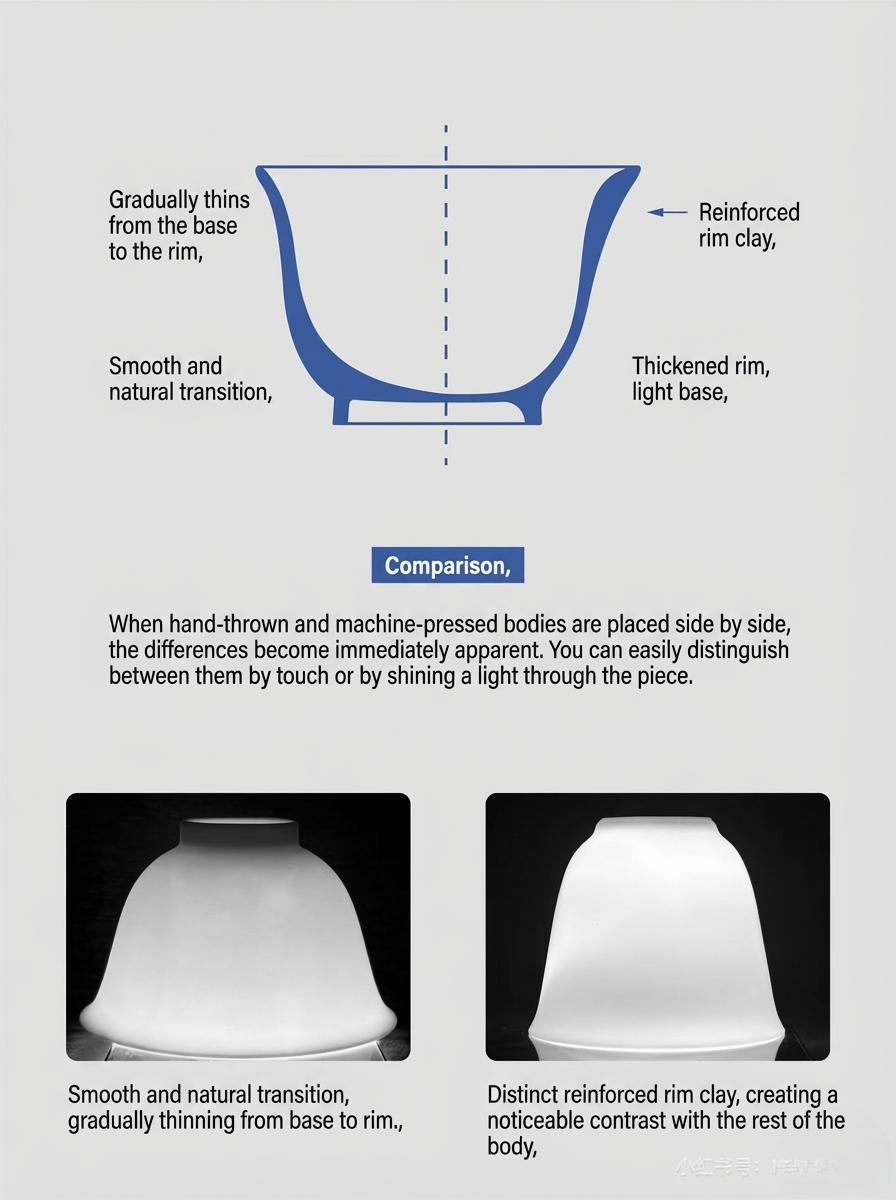
A hand-thrown cup has walls that transition in thickness smoothly and naturally. Since the throwing process pulls the clay upward from the base, the wall gradually becomes thinner from the bottom to the rim. Some shapes are intentionally trimmed to be thinner at the base and thicker at the rim for design reasons, but even then, the thickness changes evenly and without abrupt bulges.
[Machine-Pressed]
Machine-pressed bodies are formed by pressing downward. To reduce deformation and increase the firing yield, a ring of clay is usually added at the rim, making the cup top-heavy. When you shine a light through it, you’ll notice the wall thickness is uneven, with a noticeably thicker band just below the rim.
When you compare a hand-thrown and a machine-pressed body side by side, the differences become much more apparent. You can distinguish between them by touch or by shining a light through the piece. In the picture below, the body on the left is hand-thrown, while the one on the right is machine-made—feel free to use this as a reference.