
Blog
How to Distinguish High-Fired Porcelain from Low-Fired Porcelain?

As someone with many years of experience in the Jingdezhen ceramics industry, I am often asked: How can you tell the difference between high-fired porcelain and low-fired porcelain? When choosing tableware, teaware, or decorative items, which should you pick?
In Jingdezhen, high-fired porcelain is considered authentic porcelain. Low-fired porcelain is mostly ordinary ceramic, and there are huge differences between the two in firing temperature, porcelain density, safety, and lifespan. The classic descriptions—“white as jade, bright as a mirror, thin as paper, and resonant as a chime”—always refer to high-fired porcelain.
I. Core Differences: Jingdezhen High-Fired Porcelain vs. Low-Fired Porcelain
Authentic Jingdezhen high-fired porcelain is fired at 1300°C, achieving full vitrification, making the porcelain dense and hard—this is true porcelain.
Low-fired porcelain is fired at just 700°C–1100°C, resulting in incomplete vitrification and a softer, semi-ceramic, semi-porcelain texture.
The difference is obvious: high-fired porcelain is forged in intense heat, representing the essence of Jingdezhen’s centuries-old craftsmanship. Low-fired porcelain is mainly mass-produced and disposable. The gap is easy to see, feel, and experience in use.
II. Five Practical Methods for Quick Identification
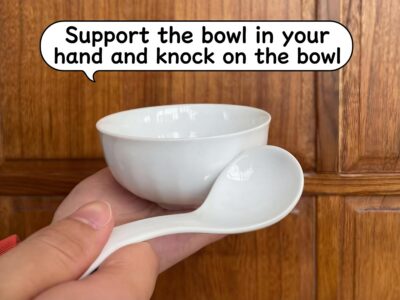
1.Sound: Clear and Resonant vs. Dull and Muffled
This is the most common method used by Jingdezhen artisans. Gently tap the surface—high-fired porcelain produces a clear, pleasant, lingering sound, like striking jade.
Low-fired porcelain sounds dull, short, and sometimes a bit hoarse, without a ringing echo.
2.Appearance: Smooth and Lustrous vs. Dull and Grayish
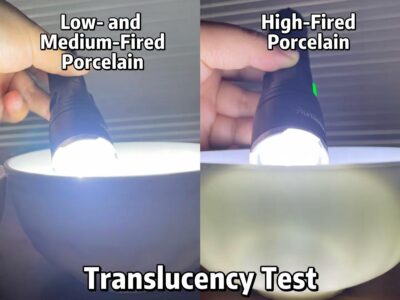
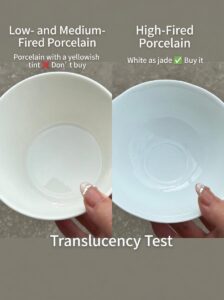
High-fired porcelain has a fine, smooth surface with pure whiteness and a glossy, translucent glaze. Even without decoration, it has a jade-like quality.
Low-fired porcelain has a dull, grayish surface, with a harsh shine and visible coarseness.
3.Touch: Dense and Smooth vs. Rough and Loose
High-fired porcelain is very dense, feels heavy and delicate, with a glaze that is tight and silky smooth—no grainy feeling at all.
Low-fired porcelain is lighter, less dense, with a loose glaze. Poor-quality low-fired porcelain may even feel uneven or bumpy.
4.Water Absorption: Non-Absorbent vs. Absorbent
High-fired porcelain is fully vitrified, with a water absorption rate of ≤0.2%, so it’s almost non-absorbent. Oil and stains wash off easily, with no risk of bacteria or mold.
Low-fired porcelain is not fully vitrified, so it absorbs water and stains, may leak or discolor over time, and can harbor bacteria.
5.Durability: Long-Lasting vs. Fragile
High-fired porcelain is resistant to high temperatures, acids, alkalis, and abrasion. It can be used in microwaves, ovens, and dishwashers, and stays bright for decades.
Low-fired porcelain cannot withstand rapid temperature changes, is prone to cracking, the glaze wears off easily, and there’s a risk of heavy metal leaching if used as tableware.
III. Why Do People in Jingdezhen Only Recommend High-Fired Porcelain?
For everyday tableware and teaware, safety always comes first.
High-fired porcelain, fired over 1300°C, fuses the glaze and porcelain together perfectly.
The color is stable, and there are no harmful substances leaching out, making it truly food-safe.
Low-fired porcelain, with its lower firing temperature and weaker glaze bonding, can have lead or cadmium leaching risks in inferior products, which is especially unsafe for tableware.
In Jingdezhen, all genuine high-end, collectible, and premium daily-use porcelain is high-fired. This is the craft handed down through generations, and the quality standard we uphold.